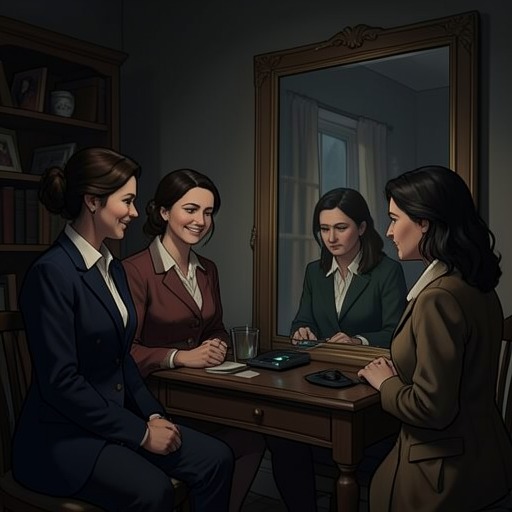
The arranged marriage of Sophia Castello and Enrique Montero
MY POSSESSIVE BILLIONAIREThe arranged marriage of Sophia Castello and Enrique Montero is the foundational bargain between two wealthy Brazilian families and the engine of the novel’s central conflict. Conceived to unite the Castello and Montero fortunes, it is initially resisted by both intended spouses, who understand it as an intrusion into their freedom. Although the arrangement is later suspended by their parents, its pressure continues to shape their choices until Enrique publicly recasts the relationship as a love match and asks Sophia to marry him by choice.
Family Pact and Business Purpose
The arrangement originates in the long friendship between Joaquin Montero II and Fredo Castello. When they were young, Fredo saved Joaquin’s life from a fire; afterward, the two men became protectors, confidants, and close allies who fought together to build their lives, businesses, and family wealth. As they grew older, protecting that wealth became their overriding priority, and they concluded that the marriage of their children was the most effective way to unite the two fortunes.
Joaquin presents the plan to Enrique while Enrique is twenty years old and studying Business Administration at Harvard University. Fredo and Marcella Castello have no son to inherit their massive wealth, while their only daughter, Sophia Castello, is described by her father as reckless and irresponsible, someone who parties, associates with boys, and dislikes studying. Joaquin therefore argues that Sophia needs a trustworthy and capable husband who can eventually manage the family business. The proposed marriage is not framed as a private romance but as an intergenerational business solution, with the Montero family’s honor serving as its moral justification.
Resistance and Conditional Consent
Enrique immediately rejects the arrangement as obsolete and incompatible with his ambitions. He insists that he is no longer a child, wants to choose his own wife, enjoys dating different women, and does not want to be tied down to Sophia. His private reaction is even more hostile: he intends to keep his mistresses, preserve a bachelor’s life, produce an heir, and divorce Sophia after a year. His consent is therefore not romantic or freely enthusiastic; it is a strategic surrender to Joaquin’s pressure and to the family’s promise.
Sophia also sees the proposed marriage as an unwanted obligation. After Fredo reminds her of the arrangement, she studies the public image of Joaquin Enrique Lopez Montero III through photographs, internet articles, blogs, and gossip. The images show him kissing and embracing different models and actresses in movie houses, restaurants, parks, cars, and even his plane. Sophia concludes that he changes lovers frequently and is interested in bedding the women he dates. Her judgment is intensified by her own determination to escape the match: she and Toni deliberately allow the press to believe that they hold wild parties whenever Fredo brings up the engagement, hoping that the scandalous image will make her supposed fiance withdraw.
The families’ language exposes the unequal pressure behind the pact. Joaquin repeatedly invokes the promise made to Fredo and the claim that the Monteros are honorable men who keep their word. Sophia objects that marriage should rest on love, trust, and respect rather than function as a joint venture designed to protect family assets. Enrique, despite privately sharing many of her objections, presents himself as more rational and more loyal to family duty, arguing that the friendship between their fathers created obligations neither child should selfishly defy.
Training and the Arrangement’s Suspension
The marriage campaign changes form after Sophia returns home and Fredo forgives her, partly because Marcella’s heart condition makes the family reluctant to continue the conflict. Fredo agrees not to pursue the marriage on the condition that Sophia undergo business training so she can manage the Castello enterprise in the future. He selects Enrique as her trainer, giving the supposedly unwanted fiance a new, practical role in Sophia’s life and sending him back into the relationship under the respectable cover of professional instruction.
The arrangement is eventually withdrawn by the parents themselves. Fredo tells Joaquin that Sophia has always been hesitant, and he and Marcella have decided that their daughter’s happiness matters more than the agreement. Joaquin accepts the change, acknowledging that the two young people cannot be forced to marry and are still young. Sophia feels relieved and happy that the arrangement is finally over. Enrique, however, listens in silence and is troubled by the fact that the news saddens him, revealing that the pact has already produced an attachment he cannot comfortably admit.
From Family Obligation to Romantic Leverage
Even after the formal pressure is removed, the arrangement continues to operate through Enrique’s conduct. His interest in Sophia becomes visible in jealousy and possessiveness. When Draco sends Sophia red roses with an invitation to dinner, Enrique reads the card, snatches the flowers from her hands, and throws them out of her office window, telling her he will buy her plenty of flowers later. The gesture turns the former family obligation into a personal claim over Sophia’s attention, while also showing how quickly protection and control become entangled.
Enrique’s surveillance of Sophia in New York follows the same pattern. After arriving at the city office and discovering that she has gone to a bar, he becomes agitated, calls her repeatedly, and asks Greg to send security personnel to search every bar in New York. He finally locates her with Marketing employees and Chris Evans, where she is participating in a tequila body-shot game. His fear that she might be kidnapped or raped is presented alongside his anger at not knowing where she is, making his concern inseparable from his desire to monitor her movements.
The relationship also develops through coercive confrontations that the narrative places inside a romantic framework. When Sophia refuses to let Enrique into her room, he threatens to have sex with her outside her door; she immediately opens it, and they enter into a furious sexual encounter. Later, at a strip club, he punches a man who challenges him, lifts Sophia over his shoulder, and slaps her while she protests and demands to be put down. He then orders her to dance and angrily accuses her of stripping for drunken men instead of for him as her fiance, threatening to fire her friends when she refuses. These scenes make the arranged marriage’s underlying power imbalance explicit: Enrique’s status, wealth, jealousy, and physical force repeatedly convert a family-sanctioned relationship into control over Sophia’s body, movements, work, and social world.
Public Recasting and Chosen Commitment
The decisive reversal comes when the parents stop insisting on the marriage and Enrique chooses to preserve the relationship himself. During the family confrontation, Marcella reacts so strongly to the possibility of losing the arrangement that Enrique declares his love for Sophia and announces that they are planning to marry as soon as possible, not because of the old agreement but because they love each other. The statement changes the marriage from a duty inherited from Joaquin and Fredo into a public claim of mutual feeling, although it also functions as an urgent attempt to repair a crisis.
The final proposal gives that new claim a more deliberate form. With the wedding already scheduled for the following Saturday, Enrique kneels before Sophia and explains that he wants to make everything right rather than lose the opportunity to ask her himself. He asks her to marry him and opens a small red velvet box containing a twenty-four-carat diamond engagement ring. The ring and the spoken proposal do not erase the coercive history of the arrangement, but they mark the story’s effort to distinguish an imposed family contract from a commitment Enrique now presents as personal choice.
Narrative Significance
The arranged marriage is therefore both plot device and ideological battleground. It joins two fortunes through the fathers’ friendship, transfers the obligations of one generation onto their children, and repeatedly tests whether family honor can justify limiting individual freedom. Sophia’s staged party scandals, Enrique’s initial plan for infidelity and divorce, their arguments over love and business, the professional training condition, and the parents’ eventual withdrawal all show the pact changing shape rather than simply disappearing.
Its most important transformation is the movement from external compulsion to declared desire. The story treats the marriage as a romance structure in which resistance gradually gives way to attachment, but the evidence also preserves the darker contradiction: Enrique’s jealousy, monitoring, threats, public violence, and physical control are repeatedly presented as expressions of possessive love. The final proposal supplies the conventional language of chosen commitment, yet its force depends on the history of the arrangement that it claims to transcend. The marriage matters because it never remains only a contract between families; it becomes the contested space in which Sophia and Enrique struggle over autonomy, reputation, loyalty, sexuality, and the meaning of consent.